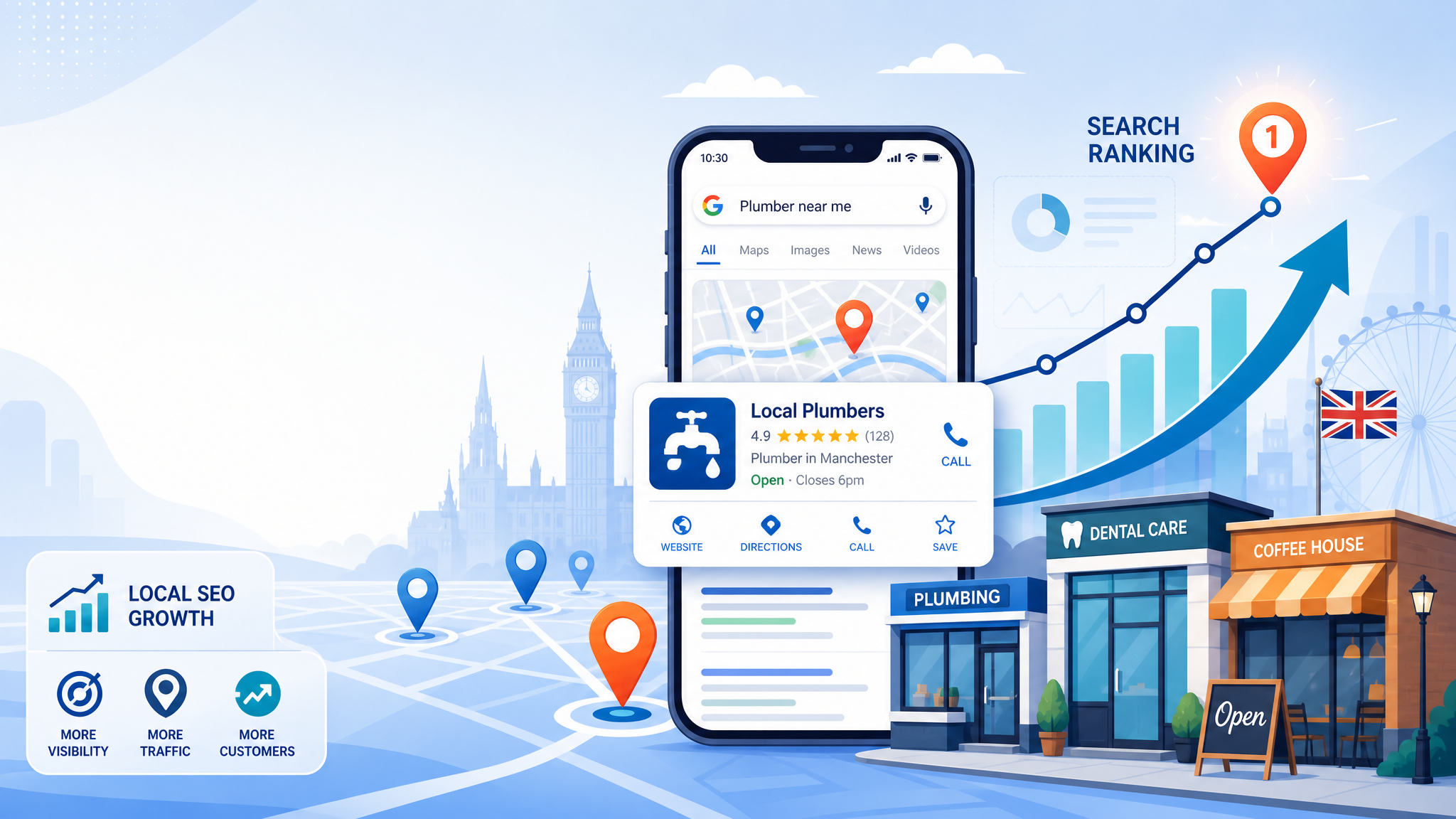
If you want your business to show up when someone nearby searches for what you offer, local SEO still does a huge amount of the heavy lifting. In the UK, that means competing in Google’s local pack, Google Maps, and standard organic results all at once. The challenge is that local visibility is influenced by a mix of profile signals, website quality, reputation, links, and plain old real-world proximity. Some factors are under your control. Some aren’t. But most can be improved. Here’s what matters most in 2026, and where you should focus first if you want better local rankings.
How Local SEO Works In The UK Search Landscape
Google uses a familiar trio for local search: relevance, distance, and prominence. That applies in the UK just as much as anywhere else, but the search landscape here has its own quirks. You’re often competing across towns, boroughs, and neighbourhood-level intent, and users frequently search with place modifiers such as “near me”, “in Leeds”, or “open now”.
In practice, local SEO in the UK is not just about your website ranking. It’s about whether Google trusts your business enough to surface it in map results for a specific location and service combination. A solicitor in Manchester, for example, might rank differently for “family solicitor Manchester city centre” than for “divorce lawyer Salford”, even if the office is only a few miles away.
That’s why local ranking factors work together. Your Google Business Profile, on-page location signals, reviews, local citations, and authority all help Google decide whether your business is a strong match for a nearby searcher.
Google Business Profile Signals That Influence Local Visibility
Your Google Business Profile is still one of the strongest local SEO assets you control. If it’s incomplete, inaccurate, or neglected, your local visibility suffers.
Start with the basics: your business name, primary category, address, phone number, website, and opening hours should be correct and up to date. Category selection matters more than many businesses realise. Your primary category tells Google what you are: secondary categories help define the full scope of your services.
You should also optimise the parts many firms ignore:
- business description
- services and products
- attributes
- high-quality photos
- regular posts
- Q&A management
In the UK, service-area businesses need to be especially careful about how they set service locations. Don’t try to overextend into places you can’t realistically serve.
And yes, activity matters. Profiles with fresh updates, new images, accurate seasonal hours, and steady engagement often perform better because they send stronger quality and trust signals.
Website Relevance And On-Page Local Optimisation
Even with a strong profile, Google still looks to your website to confirm what you do and where you do it. If your site is vague, thin, or generic, it weakens your local SEO.
Your core service pages should clearly mention your main services and target locations in a natural way. That doesn’t mean stuffing every town in the county into a paragraph. It means creating useful pages that reflect actual search intent. If you serve multiple locations, build distinct location pages with unique content, local proof, and relevant internal links.
A few on-page factors matter most:
- page titles and meta descriptions with local intent
- H1s and body copy that match search demand
- clear contact information
- embedded map or location details where relevant
- schema markup for local business details
- mobile-friendly, fast-loading pages
For UK businesses, trust markers help too. Think company registration details, local testimonials, real addresses, and content that reflects local knowledge rather than boilerplate copy.
Reviews, Reputation, And Trust Signals
Reviews influence both rankings and conversions. Google has never fully reduced local reviews to a simple number, but volume, recency, sentiment, and relevance all appear to matter.
If two similar businesses are competing in the same area, the one with a healthier review profile often has the edge. More importantly, that profile affects whether people click. A 4.8 rating with detailed, recent comments is a powerful trust signal.
Focus on generating reviews consistently, not in sudden bursts. Ask real customers at the right moment, make the process easy, and respond to feedback professionally. Responses show engagement, and they give you a chance to reinforce service keywords and locations naturally.
Don’t stop at Google, either. Depending on your sector, signals from platforms such as Trustpilot, Checkatrade, Yelp, or industry-specific directories can support credibility. What matters most is authenticity. Bought, gated, or suspiciously repetitive reviews can do more harm than good.
Local Citations, NAP Consistency, And Directory Accuracy
Citations still matter, even if they’re no longer the glamorous part of local SEO. A citation is any mention of your business name, address, and phone number, often shortened to NAP.
Google uses citation consistency as a trust check. If your details vary across major UK directories, mapping platforms, local chambers, and trade sites, that creates ambiguity. And ambiguity is bad for rankings.
Start by auditing your core listings. Your business name should be written the same way everywhere. Your address format should be consistent. Your phone number should match your website and Google Business Profile exactly.
Prioritise quality over volume. Well-known UK directories and sector-relevant listings carry more weight than dozens of low-quality submissions. If your business has moved, changed phone numbers, or rebranded, cleaning up legacy citations can make a noticeable difference. It’s not flashy work, but it often fixes the kind of trust issues that quietly hold local rankings back.
Links, Local Authority, And Community Relevance
Backlinks remain a major ranking factor, and in local SEO the best links usually combine authority with geographic relevance. A link from a respected local newspaper, business association, university, or community organisation can be far more useful than a random national directory link.
Think about the kinds of signals that prove you’re genuinely part of a place. Sponsoring a local event, partnering with nearby charities, joining a chamber of commerce, contributing expert commentary to regional press, or being featured on local supplier websites can all help.
You also need strong internal authority. Make sure your location and service pages are linked properly from your main navigation or relevant hub pages so authority flows through the site.
In short, local link building works best when it reflects real-world presence. If your business is visible and respected offline, your SEO strategy should turn that into digital authority online.
Behavioural Signals, Proximity, And Ongoing Performance Tracking
Some local ranking factors are only partly in your hands. Proximity is the obvious one: Google often prefers businesses that are physically closer to the searcher. You can’t optimise your way out of geography entirely.
But behavioural signals can strengthen your position. If users click your listing, call you, ask for directions, visit your website, and don’t bounce straight back to search results, that suggests your result satisfied intent. Better photos, sharper descriptions, stronger reviews, and more relevant landing pages can all improve those outcomes.
Tracking matters because local SEO is never really finished. You should monitor:
- Google Business Profile insights
- calls, direction requests, and website clicks
- local pack visibility by location
- organic rankings for service-plus-location terms
- review growth and response rate
- conversion quality, not just traffic
The businesses that win in 2026 won’t just optimise once. They’ll measure, refine, and keep their local presence accurate, active, and genuinely useful.