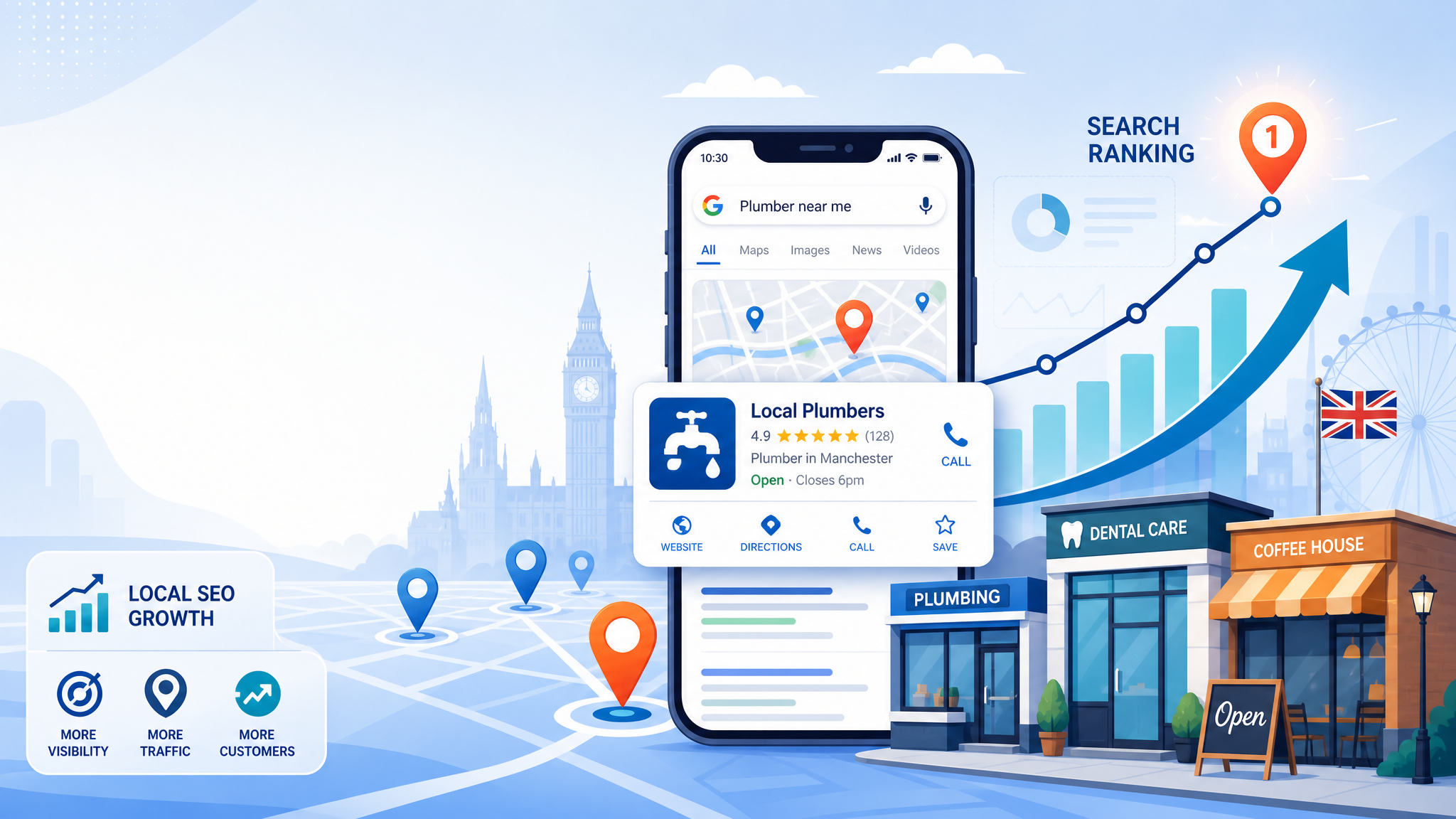
If you run a UK business with a local customer base, local SEO content is no longer a nice extra. It’s how you show up when someone searches for a plumber in Leeds, a solicitor in Bristol, or a café near Manchester Piccadilly. The challenge is scale: writing useful, location-specific content takes time. That’s where AI can help. Used well, it can speed up research, drafting, optimisation, and updates without replacing human judgement. The key is knowing where AI genuinely adds value and where your local expertise still matters most.
Why Local SEO Content Matters for UK Businesses
Local SEO content helps search engines connect your business with people searching in a specific area. That includes your town, city, borough, or service radius. If you want to rank for terms like “emergency electrician in Nottingham” or “wedding photographer in Glasgow”, you need content that clearly shows where you work and what you offer.
For UK businesses, this matters because local intent is often high intent. People searching locally are usually closer to taking action. They want opening hours, service details, pricing clues, reviews, directions, and reassurance that you actually serve their area.
Strong local content also supports your Google Business Profile, location pages, service pages, and internal linking. It gives Google more context about relevance. And just as importantly, it gives real people confidence. Thin, duplicated pages won’t do that. Useful local content can.
Where AI Adds the Most Value to Local Content Creation
AI is most useful when it removes repetitive work without removing substance. In practice, that means helping you research search themes, generate page structures, suggest FAQs, rewrite weak sections, and create first drafts faster.
It can also spot content gaps across multiple towns or services. If you serve 20 locations, AI can help you map which pages exist, which ones overlap, and where you’re missing intent-specific content. That’s a big time saver.
Another strong use case is content refreshes. AI can help turn outdated copy into clearer, more current messaging, especially for seasonal services or changing offers.
What AI does less well is lived local knowledge. It doesn’t naturally understand the difference between search behaviour in Croydon and Cheltenham unless you guide it. So think of AI as a capable assistant: fast, scalable, and useful, but not something you should leave unsupervised.
How To Use AI for Location Pages, Service Pages, and Google Business Profile Posts
For location pages, use AI to build a consistent framework: services offered, areas covered, common customer problems, trust signals, and FAQs. Then customise each page with real local detail. Mention the actual places you serve, relevant landmarks only where natural, local case studies, and practical information about response times or availability.
For service pages, AI can help you explain what the service includes, who it’s for, and what questions customers typically ask. It’s especially useful for improving clarity and adding semantically related terms that strengthen topical relevance.
For Google Business Profile posts, AI works well for short-form updates: offers, events, seasonal tips, and announcements. Keep these concise and specific. A generic AI-written post about “great customer service” adds little. A post about boiler servicing before winter in Sheffield is far more useful.
The pattern is simple: let AI create the base, then add proof, specificity, and place-level relevance.
How To Keep AI-Generated Content Accurate, Local, and Helpful
Start with strong inputs. If your prompt is vague, the output usually is too. Give AI the service, target location, customer type, tone, and any verified business details you want included. Better in, better out.
Then review every factual claim. Check postcodes, borough names, travel times, local references, pricing, regulations, and service availability. AI can sound convincing while being slightly wrong, which is often worse than being obviously wrong.
You should also add things AI can’t invent responsibly: genuine customer questions, team insight, examples from real jobs, and specific differences between locations. If your page could be swapped from Liverpool to Leicester with a quick find-and-replace, it isn’t local enough.
Most importantly, write for people first. Helpful content answers practical questions, reduces uncertainty, and reflects the reality of your business. AI should support that goal, not flatten it into bland copy.
Common Mistakes UK Businesses Should Avoid When Using AI for Local SEO
The biggest mistake is publishing near-duplicate location pages at scale. Swapping out city names and calling it a strategy is unlikely to help rankings, and it creates a poor user experience.
Another common issue is making local claims you can’t support. If you say you’re “the leading” provider across ten counties without evidence, or list areas you barely serve, that can damage trust as much as rankings.
You should also avoid over-optimised wording. Repeating phrases like “best accountant in Birmingham” five times on one page feels dated and unnatural.
And don’t let AI produce content without a brand voice or compliance check. In sectors like legal, finance, healthcare, and property, accuracy matters even more. One invented detail in an AI draft can create real problems.
Fast content is only valuable if it’s credible, distinct, and genuinely useful.
A Simple AI Workflow for Planning, Writing, and Updating Local SEO Content
A practical workflow keeps AI useful instead of chaotic.
First, plan. List your core services and target locations. Group them by search intent, not just geography. A person searching for “same-day locksmith” needs something different from someone comparing long-term security upgrades.
Second, research. Use AI to summarise SERP patterns, pull out recurring questions, and suggest page angles. Combine that with your own keyword data from tools such as Google Search Console.
Third, draft. Ask AI for structured outlines and rough copy for each page type. Be specific about tone, audience, and location.
Fourth, enrich. Add real examples, reviews, proof points, service constraints, and internal links.
Finally, update. Revisit local SEO content every few months. AI can help identify pages with outdated references, thin sections, or declining performance, so you can improve them without starting from scratch each time.
How To Measure Whether AI-Assisted Local SEO Content Is Working
You don’t measure success by how quickly AI produces content. You measure it by whether the content improves visibility and leads.
Start with rankings for local intent keywords, but don’t stop there. Track impressions, clicks, and click-through rate in Google Search Console. Look at whether your location and service pages are earning more non-branded traffic over time.
Then check engagement signals. Are people staying on the page? Are they visiting contact or quote pages next? Are they calling, submitting forms, or requesting directions through your Google Business Profile?
You should also compare page groups. If AI-assisted pages consistently underperform human-edited ones, that tells you the workflow needs work. If edited AI drafts perform well, you’ve found a scalable model.
The real test is simple: more relevant local traffic, better-quality enquiries, and stronger visibility in the areas you want to win.